
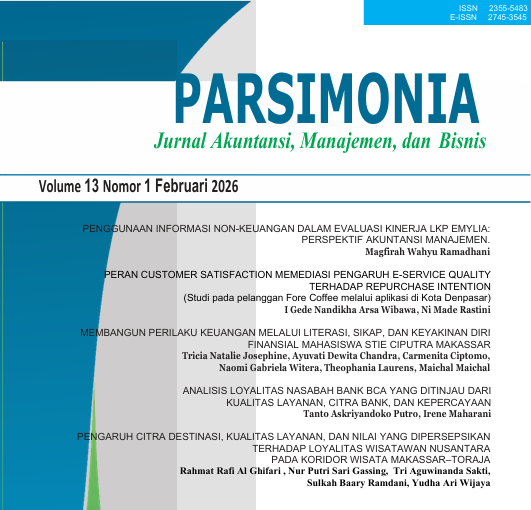
PENGGUNAAN INFORMASI NON-KEUANGAN DALAM EVALUASI KINERJA LKP EMYLIA: PERSPEKTIF AKUNTANSI MANAJEMEN
DOI:
https://doi.org/10.33479/parsimonia.v13i1.1473Keywords:
Management Accounting, Non-Financial Information, Performance EvaluationAbstract
This study aims to understand the types of non-financial information used, how such information is interpreted by management, and its role in supporting institutional performance evaluation. This research employed a qualitative approach with a case study design. Data were collected through semi-structured interviews, observation, and documentation, and were analyzed using thematic analysis. The findings indicate that LKP Emylia has used non-financial information as a basis for performance evaluation in an informal and contextual manner. Such information helps management assess service quality, learning effectiveness, instructor performance, and participant success after completing the training program. However, the use of non-financial information has not been fully documented in a structured evaluation system. The contribution of this study lies in enriching management accounting literature in the context of non-formal education institutions by showing that non-financial information plays an important role in evaluating performance, service quality, and institutional sustainability.
References
Ahmed, S. K. (2024). The pillars of trustworthiness in qualitative research. Journal of Medicine, Surgery, and Public Health, 2, 100051. https://doi.org/10.1016/j.glmedi.2024.100051
Alves, I., & Lourenço, S. M. (2022). The use of non-financial performance measures for managerial compensation: evidence from SMEs. Journal of Management Control, 33(2), 151–187. https://doi.org/10.1007/s00187-022-00337-8
Armitage, H. M., Webb, A., & Glynn, J. (2016). The Use of Management Accounting Techniques by Small and Medium-Sized Enterprises: A Field Study of Canadian and Australian Practice. Accounting Perspectives, 15(1), 31–69. https://doi.org/10.1111/1911-3838.12089
Azudin, A., & Mansor, N. (2018). Management accounting practices of SMEs: The impact of organizational DNA, business potential and operational technology. Asia Pacific Management Review, 23(3), 222–226. https://doi.org/10.1016/j.apmrv.2017.07.014
Busetto, L., Wick, W., & Gumbinger, C. (2020). How to use and assess qualitative research methods. Neurological Research and Practice, 2(1), 14. https://doi.org/10.1186/s42466-020-00059-z
Campbell, S., Greenwood, M., Prior, S., Shearer, T., Walkem, K., Young, S., Bywaters, D., & Walker, K. (2020). Purposive sampling: complex or simple? Research case examples. Journal of Research in Nursing, 25(8), 652–661. https://doi.org/10.1177/1744987120927206
Chong, V. K., Mia, L., Sands, J., & Wang, Z. A. (2023). The effect of nonfinancial performance measures, absorptive capacity, and organizational learning on innovation performance. Journal of Management Control, 34(2), 201–233. https://doi.org/10.1007/s00187-023-00355-0
De Jesus Alvares Mendes Junior, I., & Alves, M. D. C. (2023). The balanced scorecard in the education sector: A literature review. Cogent Education, 10(1). https://doi.org/10.1080/2331186X.2022.2160120
Deasy Maya Sari, M. Nasor, & Ritawati. (2024). Fungsi Lembaga Kursus dan Pelatihan Dalam Pemberdayaan Peserta Perspektif Etika Bisnis Syariah. Syarikat: Jurnal Rumpun Ekonomi Syariah, 7(1), 236–245. https://doi.org/10.25299/syarikat.2024.vol7(1).16359
Guo, T., Li, T., & Qi, Z. (2024). Perceived school service quality and vocational students’ learning satisfaction: Mediating role of conceptions of vocational education. PLOS ONE, 19(8), e0307392. https://doi.org/10.1371/journal.pone.0307392
Heinicke, A. (2018). Performance measurement systems in small and medium-sized enterprises and family firms: a systematic literature review. Journal of Management Control, 28(4), 457–502. https://doi.org/10.1007/s00187-017-0254-9
Kiger, M. E., & Varpio, L. (2020). Thematic analysis of qualitative data: AMEE Guide No. 131. Medical Teacher, 42(8), 846–854. https://doi.org/10.1080/0142159X.2020.1755030
Lestari, R. D., Retnowati, E., Sasmita, K., & Purnama Dewi, I. (2024). PENGELOLAAN BERBASIS FINANCIAL SUSTAINABILITY PADA LEMBAGA KURSUS DAN PELATIHAN DI JAWA BARAT. Journal Of Lifelong Learning, 7(2), 76–87. https://doi.org/10.33369/joll.7.2.76-87
Lisi, S., Mignacca, B., & Grimaldi, M. (2024). Non-financial reporting and SMEs: A systematic review, research agenda, and novel conceptualization. Journal of Management & Organization, 30(3), 600–622. https://doi.org/10.1017/jmo.2023.43
Morgan, H. (2022). Conducting a Qualitative Document Analysis. The Qualitative Report. https://doi.org/10.46743/2160-3715/2022.5044
Nowell, L. S., Norris, J. M., White, D. E., & Moules, N. J. (2017). Thematic Analysis. International Journal of Qualitative Methods, 16(1). https://doi.org/10.1177/1609406917733847
Pamungkas, A. H., & Ningrum, T. A. (2021). The Readiness of Course and Training Agency (LKP) in Link & Match Program with Business and Industry Sector. Digital Press Social Sciences and Humanities, 7, 00002. https://doi.org/10.29037/digitalpress.47392
Papulová, Z., Gažová, A., Šlenker, M., & Papula, J. (2021). Performance Measurement System: Implementation Process in SMEs. Sustainability, 13(9), 4794. https://doi.org/10.3390/su13094794
Pelz, M. (2019). Can Management Accounting Be Helpful for Young and Small Companies? Systematic Review of a Paradox. International Journal of Management Reviews, 21(2), 256–274. https://doi.org/10.1111/ijmr.12197
Priya, A. (2021). Case Study Methodology of Qualitative Research: Key Attributes and Navigating the Conundrums in Its Application. Sociological Bulletin, 70(1), 94–110. https://doi.org/10.1177/0038022920970318
Roffia, P., Benavides, M. M., & Carrilero, A. (2024). Cost accounting practices in SMEs: liability of age and other factors that hinder or burst its implementation in turbulent years. International Entrepreneurship and Management Journal, 20(1), 115–139. https://doi.org/10.1007/s11365-023-00938-2
Saksono, L. A., & Bernardus, D. (2023a). Design of Balanced Scorecard as a School’s Performance Measurement. Binus Business Review, 14(2), 171–183. https://doi.org/10.21512/bbr.v14i2.8901
Saksono, L. A., & Bernardus, D. (2023b). Design of Balanced Scorecard as a School’s Performance Measurement. Binus Business Review, 14(2), 171–183. https://doi.org/10.21512/bbr.v14i2.8901
Sibbald, S. L., Paciocco, S., Fournie, M., Van Asseldonk, R., & Scurr, T. (2021). Continuing to enhance the quality of case study methodology in health services research. Healthcare Management Forum, 34(5), 291–296. https://doi.org/10.1177/08404704211028857
Ylä-Kujala, A., Kouhia-Kuusisto, K., Ikäheimonen, T., Laine, T., & Kärri, T. (2023). Management accounting adoption in small businesses: interfaces with challenges and performance. Journal of Accounting & Organizational Change, 19(6), 46–69. https://doi.org/10.1108/JAOC-07-2022-0100
Downloads
Published
Issue
Section
License
Makalah yang disampaikan diasumsikan tidak mengandung bahan proprietary yang tidak dilindungi oleh hak paten atau aplikasi paten; tanggung jawab untuk konten teknis dan untuk perlindungan dari bahan proprietary merupakan tanggung jawab penulis dan organisasi mereka dan bukan tanggung jawab dari Jurnal Parsimonia atau Staff Pengelolanya. Penulis utama (pertama/yang sesuai) bertanggung jawab untuk memastikan bahwa artikel tersebut telah dilihat dan disetujui oleh semua penulis lain. Hal ini merupakan tanggung jawab penulis untuk mendapatkan semua izin pelepasan hak cipta yang diperlukan untuk penggunaan setiap materi dalam naskah sebelum pengajuan.