
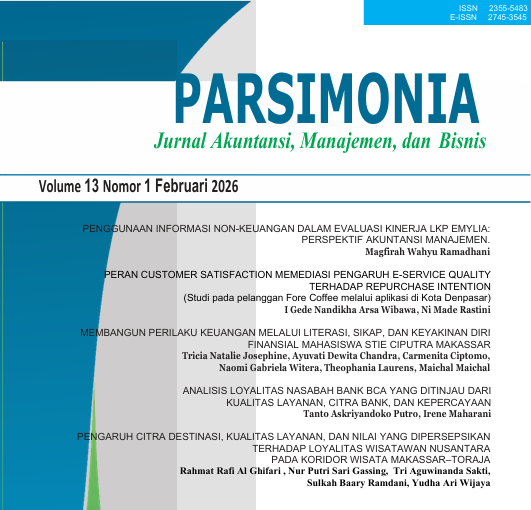
ANALISIS LOYALITAS NASABAH BANK BCA YANG DITINJAU DARI KUALITAS LAYANAN, CITRA BANK, DAN KEPERCAYAAN
DOI:
https://doi.org/10.33479/parsimonia.v13i1.1327Keywords:
Service Quality, Bank Image, Trust, Loyalty, LoyaltyAbstract
This study aims to examine and analyze the influence of service quality, bank image, and trust on customer loyalty at Bank Central Asia (BCA) Blitar Branch. The research method used was a quantitative approach with systematic data analysis. The results showed that all three independent variables significantly influenced customer loyalty. Service quality was shown to have a positive effect, meaning that the better the service provided, the higher the customer loyalty. Bank image also had a significant impact, where positive public perception of the bank's reputation increased customer loyalty. Furthermore, customer trust in BCA plays a crucial role in strengthening long-term relationships between customers and the bank. Overall, these findings confirm that service quality, bank image, and trust are key factors that complement each other in building and enhancing customer loyalty at BCA Blitar Branch.
References
Barney, J. B. (2020). Gaining and sustaining competitive advantage (6th ed.). Pearson.
Chatterjee, S., Rana, N. P., Tamilmani, K., & Sharma, A. (2021). The impact of digital customer relationship management on customer loyalty: Evidence from service industries. Information Systems Frontiers, 23(1), 101–117. https://doi.org/10.1007/s10796-020-10013-2
Foroudi, P., Jin, Z., Gupta, S., Melewar, T. C., & Foroudi, M. M. (2018). Influence of innovation capability and customer experience on reputation and loyalty. Journal of Business Research, 88, 149–161. https://doi.org/10.1016/j.jbusres.2018.03.017
Hennig-Thurau, T., Gwinner, K. P., & Gremler, D. D. (2019). Understanding relationship marketing outcomes: Customer loyalty and retention. Journal of Marketing, 63(4), 211–226.
Klaus, P., & Maklan, S. (2016). Bridging the gap for customer experience: A framework for research. Journal of Service Management, 27(5), 88–106.
Kumar, V., & Reinartz, W. (2016). Creating enduring customer value. Journal of Marketing, 80(6), 36–68. https://doi.org/10.1509/jm.15.0414
Ladhari, R. (2020). Service quality, emotional satisfaction, and behavioural intentions. Managing Service Quality, 20(2), 134–144. https://doi.org/10.1108/09604521011027579
Lemon, K. N., & Verhoef, P. C. (2016). Understanding customer experience throughout the customer journey. Journal of Marketing, 80(6), 57–71. https://doi.org/10.1509/jm.15.0420
Moliner-Velázquez, B., Ruiz-Molina, M. E., & Fayos-Gardó, T. (2019). Satisfaction with service recovery: Moderating effect of age in word-of-mouth. Journal of Retailing and Consumer Services, 50, 54–63. https://doi.org/10.1016/j.jretconser.2019.05.001
Nguyen, B., Simkin, L., & Canhoto, A. (2020). The dark side of digital personalization: An agenda for research and practice. Journal of Business Research, 116, 209–221. https://doi.org/10.1016/j.jbusres.2020.05.028
Porter, M. E. (2019). Competitive advantage: Creating and sustaining superior performance. Free Press.
Rather, R. A. (2018). Investigating the impact of customer brand identification on hospitality brand loyalty: A social identity perspective. Journal of Hospitality Marketing & Management, 27(6), 67–84. https://doi.org/10.1080/19368623.2018.1443725
Downloads
Published
Issue
Section
License
Makalah yang disampaikan diasumsikan tidak mengandung bahan proprietary yang tidak dilindungi oleh hak paten atau aplikasi paten; tanggung jawab untuk konten teknis dan untuk perlindungan dari bahan proprietary merupakan tanggung jawab penulis dan organisasi mereka dan bukan tanggung jawab dari Jurnal Parsimonia atau Staff Pengelolanya. Penulis utama (pertama/yang sesuai) bertanggung jawab untuk memastikan bahwa artikel tersebut telah dilihat dan disetujui oleh semua penulis lain. Hal ini merupakan tanggung jawab penulis untuk mendapatkan semua izin pelepasan hak cipta yang diperlukan untuk penggunaan setiap materi dalam naskah sebelum pengajuan.